Age Spot Removal in Gangnam, Seoul
Gangnam DIORE Clinic
Target Age Spots, Sunspots and Brown Pigmentation with Personalized Laser Treatment
Age Spot Removal in Gangnam, Seoul | DIORE Clinic Gangnam
Age Spot Removal is a pigmentation treatment designed to reduce visible brown spots that commonly develop after years of sun exposure. Also known as sunspots, solar lentigines, or liver spots, age spots often appear on areas that receive frequent ultraviolet exposure, including the face, cheeks, temples, hands, neck, and décolletage.
At DIORE Clinic in Gangnam, Seoul, age spot treatments can be personalized according to the size, color, depth, number, and distribution of pigmentation as well as the patient's skin tone and individual treatment goals.
Depending on the characteristics of the pigmentation, treatment options may include Pico Laser, pigment-targeting laser treatment, IPL Photofacial, or a customized combination approach.
The goal is to reduce unwanted pigmentation and create a clearer, brighter, and more even-looking complexion while preserving the patient's natural skin tone.
🔹 What Are Age Spots?
Age spots are flat areas of increased pigmentation that usually appear brown, tan, or dark brown.
They commonly develop on areas exposed to sunlight over many years.
Typical locations include:
- Face
- Cheeks
- Temples
- Forehead
- Nose
- Neck
- Décolletage
- Shoulders
- Arms
- Backs of the hands
Age spots are strongly associated with accumulated ultraviolet exposure rather than aging alone.
This is why they are also commonly called sunspots or solar lentigines.
🔹 What Causes Age Spots?
Age spots develop when melanin becomes concentrated in selected areas of the skin.
Contributing factors may include:
- Long-term sun exposure
- Repeated UV exposure
- Natural skin aging
- Genetic tendency
- Outdoor lifestyle
- Previous tanning
- Inadequate sun protection
As UV exposure accumulates over time, areas of concentrated pigmentation can become more visible.
Age spots can gradually increase in number or become darker with additional sun exposure.
🔹 Are Age Spots the Same as Liver Spots?
Yes. The term liver spot is an older common name for age spots.
Despite the name, ordinary age spots are not caused by the liver.
They are generally associated with accumulated sun exposure and changes in melanin distribution within the skin.
The medical term often used for typical sun-related age spots is solar lentigines.
🔹 Can Age Spots Be Removed?
Many age spots can be significantly lightened with appropriate laser or light-based treatment.
Treatment works by targeting excess melanin within the brown spot.
The pigmentation absorbs energy from the selected device, allowing targeted pigment to break down or undergo a controlled treatment response.
As the treated skin recovers, the visible spot may:
- Temporarily darken
- Develop fine crusting
- Gradually fade
- Become significantly lighter
- Blend more evenly with surrounding skin
The amount of improvement varies according to the type and depth of pigmentation.
🔹 What Is the Best Treatment for Age Spots?
There is no single best treatment for every patient.
The appropriate technology depends on factors such as:
- Number of age spots
- Spot size
- Pigment depth
- Pigment color
- Distribution
- Skin tone
- Presence of freckles
- Presence of facial redness
- Other pigmentation conditions
- Previous treatments
- Desired downtime
At DIORE Clinic Gangnam, treatment may be selected after evaluating the pigmentation pattern rather than treating every brown spot with the same device.
🔹 Pico Laser for Age Spot Removal
Pico Laser uses extremely short picosecond pulses to target unwanted pigmentation.
These rapid pulses can generate a photoacoustic effect that helps fragment selected pigment into smaller particles.
Pico Laser may be considered for:
- Defined age spots
- Sunspots
- Brown pigmentation
- Freckles
- Selected post-inflammatory pigmentation
- Uneven-looking skin tone
For patients with isolated or clearly defined brown spots, targeted Pico Laser treatment may allow individual lesions to be treated precisely.
🔹 IPL for Age Spot Removal
IPL Photofacial uses broad-spectrum pulses of light and may be particularly useful when age spots are distributed over a wider area.
IPL can target melanin in superficial brown pigmentation and may simultaneously address selected redness and signs of photodamage.
IPL may be considered when patients have:
- Multiple sunspots
- Diffuse superficial pigmentation
- Freckles
- Uneven skin tone
- Facial redness
- General sun damage
- Dull complexion
After IPL, treated brown spots can initially become darker before gradually fading or flaking naturally.
🔹 Pico Laser vs. IPL for Age Spots
Patients frequently ask whether Pico Laser or IPL is better for age spot removal.
The answer depends on the pigmentation pattern.
Pico Laser may be considered when:
- Individual spots are well defined
- Focused pigment treatment is desired
- Brown pigmentation is the primary concern
- Selected lesions require precise targeting
IPL may be considered when:
- Multiple age spots are spread across the face
- Freckles are also present
- Redness accompanies pigmentation
- General photodamage is present
- Overall skin-tone improvement is desired
Some patients may benefit from using different technologies at different stages.
🔹 Age Spots vs. Freckles
Age spots and freckles can both appear as brown marks, but they are different pigmentation patterns.
Freckles often:
- Begin earlier in life
- Have a strong genetic component
- Become darker after sun exposure
- Appear as numerous small spots
Age spots often:
- Become more noticeable with accumulated sun exposure
- Tend to persist throughout the year
- Can be larger than freckles
- Commonly develop on chronically sun-exposed areas
Treatment may overlap, but accurate assessment helps determine the best settings and technology.
🔹 Age Spots vs. Melasma
Age spots should also be differentiated from melasma.
Age spots are generally more clearly defined individual brown lesions.
Melasma usually appears as broader, irregular patches of brown or gray-brown pigmentation.
Melasma may be influenced by:
- Hormones
- Genetics
- UV exposure
- Heat
- Skin inflammation
Because melasma can respond unpredictably to aggressive laser treatment, it should not automatically be treated like an ordinary age spot.
🔹 Age Spots vs. Seborrheic Keratosis
Not every brown raised lesion is a simple age spot.
Seborrheic keratoses are common benign growths that may appear brown, tan, or dark and can become more noticeable with age.
They may look:
- Raised
- Rough
- Waxy
- Stuck onto the skin
These lesions differ structurally from flat solar lentigines and may require a different treatment method.
A clinical assessment is important before cosmetic removal.
🔹 Age Spots vs. Moles
Age spots and moles are also different.
Typical age spots are generally flat areas of increased pigmentation caused by sun exposure.
Moles are melanocytic lesions that can have different biological characteristics.
Any brown lesion that is:
- Changing
- Asymmetrical
- Irregularly bordered
- Multiple colors
- Bleeding
- Painful
- Rapidly enlarging
should be medically assessed before cosmetic laser treatment.
🔹 Age Spot Removal on the Face
The face is one of the most common areas for age spots because it receives years of cumulative sun exposure.
Frequently treated areas include:
- Cheeks
- Temples
- Forehead
- Nose
- Jawline
- Full face
Treatment may focus on individual spots or broader areas of sun-related pigmentation.
Patients with several different pigmentation types may require more than one treatment approach.
🔹 Age Spot Removal on the Cheeks
Age spots frequently appear on the upper cheeks, especially in patients with a history of significant sun exposure.
Depending on whether the pigmentation is isolated or widespread, treatment may involve:
- Targeted laser treatment
- IPL Photofacial
- Broader pigmentation treatment
- Combination approaches
Cheek pigmentation should also be differentiated from melasma before treatment.
🔹 Age Spot Removal on the Hands
The backs of the hands are another common location for age spots.
Because hands receive significant lifelong sun exposure, brown pigmentation can become increasingly visible over time.
Laser or light-based treatment may be considered for selected hand pigmentation.
However, skin on the hands differs from facial skin, so treatment settings and recovery expectations should be adjusted accordingly.
🔹 Age Spot Removal on the Neck and Décolletage
Sunspots can also appear on the:
- Neck
- Upper chest
- Décolletage
- Shoulders
These areas may show a combination of pigmentation, redness, and photodamage.
Depending on the pattern, a broader light-based treatment or targeted pigmentation treatment may be considered.
Treatment intensity should be customized because healing characteristics vary by body area.
🔹 Who Is a Good Candidate for Age Spot Removal?
Age spot treatment may be suitable for patients who:
- Have visible sunspots
- Have flat brown pigmentation
- Have uneven sun-related skin tone
- Want a clearer-looking complexion
- Have multiple superficial brown spots
- Prefer non-surgical treatment
- Can follow appropriate sun protection
- Understand that additional pigmentation can develop in the future
Treatment suitability depends on accurate identification of the lesion.
🔹 Is Age Spot Removal Suitable for Every Skin Type?
Pigmentation treatment requires careful consideration of natural skin tone.
Because laser and light treatments target melanin, surrounding normal skin can also absorb energy.
Patients with darker skin or a history of post-inflammatory hyperpigmentation may require:
- Carefully selected wavelengths
- Conservative treatment settings
- Longer intervals
- Additional sun protection
- Alternative treatment strategies
Individual treatment planning can help reduce the risk of unwanted pigmentation changes.
🔹 What Happens During Age Spot Removal?
A typical treatment process may include:
1. Pigmentation Assessment
Brown spots are evaluated according to their appearance, depth, distribution, and likely cause.
2. Skin Cleansing
Makeup, sunscreen, and surface products are removed.
3. Laser or Light Treatment
Selected spots or treatment areas receive controlled laser or IPL energy.
4. Cooling or Soothing Care
Post-treatment soothing care may be provided depending on the skin response.
5. Aftercare Guidance
Patients receive instructions regarding skincare and sun protection.
🔹 Age Spot Removal Treatment Time
Treatment Time: Approximately 15–45 minutes depending on the number and size of spots
Anesthesia: Often not required; topical numbing may be considered depending on treatment type
Sensation: Mild snapping, warmth, tingling, or prickling may occur
Treatment Areas: Face, neck, chest, hands, arms, or selected sun-exposed areas
Downtime: Generally limited, depending on the technology and treatment intensity
At DIORE Clinic Gangnam, treatment parameters can be adjusted according to pigmentation type, skin tone, and treatment goals.
🔹 Does Age Spot Removal Hurt?
Most pigmentation treatments produce brief sensations.
Patients may feel:
- Mild snapping
- Warmth
- Tingling
- Light prickling
Individual sensitivity varies.
Cooling or topical numbing may be considered depending on the treatment technology and area.
🔹 What Happens to Age Spots After Laser Treatment?
After pigment-focused treatment, an age spot may initially look darker.
This can be a normal part of the treatment response.
Over the following days, treated pigmentation may:
- Darken
- Become dry
- Form light superficial crusting
- Gradually flake
- Fade
- Become less noticeable
Patients should allow treated pigmentation to shed naturally.
Picking or scratching can increase irritation and pigmentation risk.
🔹 Why Do Age Spots Get Darker After Laser?
Laser or IPL energy is absorbed by melanin within the treated area.
This may cause the targeted pigmentation to temporarily become darker and more visible.
As the skin recovers, the darkened pigment can gradually fade or shed.
Patients should not interpret every temporary darkening as treatment failure.
🔹 Age Spot Removal Downtime
Age spot treatments often involve less downtime than intensive laser resurfacing.
Possible temporary effects include:
- Redness
- Mild swelling
- Warmth
- Skin sensitivity
- Darkening of treated spots
- Fine crusting
- Dryness
Visible darkening may remain for several days even when the patient feels comfortable returning to normal daily activities.
🔹 Age Spot Removal Aftercare
Aftercare is important for both healing and pigmentation control.
Patients may be advised to:
- Use broad-spectrum sunscreen
- Minimize direct sun exposure
- Avoid tanning
- Keep the skin moisturized
- Use gentle cleansing products
- Avoid picking treated spots
- Avoid aggressive exfoliation
- Temporarily avoid strong acids or retinoids when instructed
- Avoid unnecessary heat exposure immediately after treatment
- Follow individualized post-treatment instructions
🔹 Why Is Sunscreen Important After Age Spot Removal?
Age spots are closely linked to cumulative UV exposure.
Laser treatment can reduce existing pigmentation, but it cannot prevent the skin from producing future sun-related pigment.
Consistent sun protection can help:
- Protect recovering skin
- Reduce post-inflammatory pigmentation
- Limit development of new age spots
- Reduce darkening of residual pigmentation
- Maintain a more even-looking complexion
Sun protection is especially important during outdoor activities after treatment.
🔹 When Will I See Results?
Visible improvement depends on the treatment used.
For targeted brown spots, changes may become noticeable after the treated area completes its initial darkening and shedding process.
With broader IPL or pigmentation treatment, improvement may develop progressively.
Patients may notice:
- Lighter age spots
- Fewer visible brown spots
- More even-looking skin
- Improved brightness
- Clearer complexion
Results vary by individual.
🔹 How Many Sessions Are Needed for Age Spot Removal?
Some superficial age spots may respond noticeably after one treatment.
Others may require multiple sessions.
The number depends on:
- Pigment depth
- Number of spots
- Spot size
- Treatment technology
- Skin tone
- Previous sun damage
- Individual response
- Desired improvement
A treatment course should be based on how the pigmentation responds rather than a fixed session number.
🔹 Can Age Spots Be Removed in One Session?
Some individual age spots can show substantial improvement after a single treatment, but one-session removal cannot be guaranteed.
Multiple treatments may be required when:
- Pigmentation is extensive
- Spots have different depths
- The treatment is performed conservatively
- There is significant photodamage
- Several types of pigmentation are present
A gradual approach may be safer for patients prone to pigmentation changes.
🔹 Do Age Spots Come Back After Laser Treatment?
A successfully treated individual spot may remain substantially lighter.
However, additional age spots can develop later because the underlying effects of UV exposure and skin aging continue.
Recurrence or new spots may be influenced by:
- Continued sun exposure
- Previous cumulative UV damage
- Natural aging
- Skin type
- Individual pigmentation tendency
Maintenance treatment may therefore be considered in the future.
🔹 Is Age Spot Removal Permanent?
Laser treatment can produce long-lasting improvement in successfully treated pigmentation, but it cannot permanently stop new sunspots from developing.
Daily sun protection is one of the most important ways to help preserve treatment results.
Patients with extensive lifelong sun exposure may continue developing new pigmentation over time.
🔹 Can Laser Age Spot Removal Cause Hyperpigmentation?
Post-inflammatory hyperpigmentation is a possible side effect of pigmentation treatment.
It occurs when the treated area becomes darker after inflammation.
Risk may be influenced by:
- Natural skin tone
- Treatment intensity
- Laser wavelength
- Sun exposure
- Skin sensitivity
- Individual pigmentation tendency
Careful treatment selection and aftercare can help reduce risk.
🔹 Can Age Spot Removal Cause Hypopigmentation?
Hypopigmentation means that treated skin becomes lighter than surrounding skin.
It can occur if normal melanin is affected during treatment.
Risk may depend on:
- Laser settings
- Number of treatments
- Skin type
- Treatment intensity
- Pigmentation depth
Customized treatment is important to balance pigment clearance and skin safety.
🔹 Are Age Spots Dangerous?
Typical age spots are generally benign.
However, not every brown lesion that looks like an age spot is necessarily a simple solar lentigo.
Pigmented lesions that change or look unusual should be evaluated before cosmetic removal.
Patients should seek assessment if a spot:
- Changes rapidly
- Develops irregular borders
- Has multiple colors
- Bleeds
- Becomes painful
- Changes texture
- Grows noticeably
- Looks significantly different from surrounding spots
Cosmetic treatment should not replace appropriate diagnosis.
🔹 Can Raised Age Spots Be Treated with Laser?
A raised brown lesion may not actually be an ordinary age spot.
Raised lesions can include seborrheic keratoses or other skin growths.
These may require different treatment than flat pigmentation.
For that reason, lesion type should be confirmed before choosing a pigment laser.
🔹 Can Age Spots Be Removed Without Laser?
Alternative approaches may include:
- Medical-grade pigmentation skincare
- Chemical peels in selected cases
- Prescription topical treatments
- Sun protection
- Other professional pigmentation procedures
Topical approaches generally produce more gradual changes than targeted laser or light treatment.
The appropriate choice depends on the type and extent of pigmentation.
🔹 Can Age Spot Removal Improve Overall Skin Tone?
When multiple brown spots contribute to an uneven complexion, reducing visible pigmentation can make the skin appear:
- Brighter
- Clearer
- More even
- More refreshed
- Less sun damaged
The objective is to reduce localized excess pigmentation rather than alter the patient's natural skin color.
🔹 Can Age Spot Removal Be Combined with Other Treatments?
Yes, depending on skin condition.
Patients with age spots may also have:
- Freckles
- Facial redness
- Enlarged pores
- Fine lines
- Rough texture
- Post-acne marks
- Other signs of photodamage
A customized plan may use different treatments for different targets.
For example, pigmentation treatment may be combined or staged with procedures for redness, texture, or overall rejuvenation.
🔹 Is Age Spot Removal Good Before an Event?
Because treated age spots can temporarily become darker, treatment should not necessarily be scheduled immediately before an important event.
Patients should consider sufficient recovery time before:
- Weddings
- Photoshoots
- Important meetings
- Public appearances
- Special events
The ideal timing depends on the treatment technology and individual skin response.
🔹 Age Spot Removal in Korea for International Patients
Korea is a popular destination for pigmentation treatment and aesthetic laser procedures, with Gangnam, Seoul attracting international patients interested in advanced Korean skin care.
Age spot treatment may be convenient for travelers because many procedures involve relatively manageable downtime.
International patients should nevertheless consider:
- Temporary darkening of treated spots
- Outdoor sun exposure
- Length of stay
- Important events
- Photography
- Other planned procedures
- Whether additional sessions may be needed
🔹 Can I Get Age Spot Removal During a Trip to Seoul?
Yes, suitable international patients may receive age spot treatment while visiting Seoul.
Low-downtime pigment treatments can often fit into a travel itinerary.
However, visitors should pay particular attention to sun protection because outdoor sightseeing can expose recently treated skin to significant UV radiation.
Treatment should ideally be scheduled around important photographs, events, and outdoor activities.
🔹 Can I Fly After Age Spot Removal?
Many patients can travel after low-downtime pigmentation treatment.
However, individual recommendations depend on treatment intensity and skin reaction.
The skin may temporarily feel sensitive or dry, and treated brown spots can remain darker during the early recovery period.
Patients should continue gentle skincare and follow their clinic's instructions while traveling.
🔹 How Is Age Spot Removal Different from Skin Whitening?
Age spot removal targets specific areas of unwanted excess pigmentation.
It does not aim to bleach the skin or change the patient's natural skin tone.
By reducing selected brown spots, the surrounding complexion may simply appear clearer and more even.
🔹 Key Benefits of Age Spot Removal
- Targets visible sunspots and age spots
- Helps reduce brown pigmentation
- Can improve uneven-looking skin tone
- Helps create a clearer complexion
- May address individual spots or larger treatment areas
- Pico Laser or IPL may be selected according to pigmentation pattern
- Non-surgical treatment
- Generally manageable downtime
- Can be customized according to skin type
- May improve visible signs of photodamage
- Suitable for selected face, neck, chest, hand, and body areas
- Can be incorporated into a broader skin rejuvenation plan
✨ Why Choose Age Spot Removal at DIORE Clinic Gangnam?
DIORE Clinic in Gangnam, Seoul provides personalized aesthetic pigmentation treatment for Korean and international patients seeking improvement in age spots, sunspots, freckles, and uneven skin tone.
Patients can benefit from:
- Individual pigmentation assessment
- Differentiation between age spots and other brown lesions
- Personalized laser or light-based treatment selection
- Customized Pico Laser parameters when appropriate
- IPL treatment options for broader photodamage when appropriate
- Treatment planning according to pigment depth and skin tone
- Consideration of pigmentation risk and recurrence
- Combination treatment planning when suitable
- Advanced Korean aesthetic technology
- Convenient location in Gangnam, Seoul
- Foreigner-friendly care for international visitors
- Treatment planning that considers travel schedule and available downtime
🔹 Frequently Asked Questions About Age Spot Removal in Gangnam
What are age spots?
Age spots are flat brown or tan areas of pigmentation commonly associated with accumulated sun exposure. They are also called sunspots, liver spots, or solar lentigines.
Can laser remove age spots?
Selected age spots may respond well to pigment-targeting laser treatment. The result depends on the type, depth, size, and color of the pigmentation.
What is the best laser for age spots?
There is no single best laser for every patient. Pico Laser, other pigment-targeting lasers, or IPL may be considered depending on the pigmentation pattern and skin characteristics.
Is Pico Laser good for age spots?
Pico Laser may be useful for selected age spots and sunspots by targeting unwanted melanin with extremely short laser pulses.
Is IPL good for age spots?
IPL may be useful when multiple superficial sunspots are distributed over a broader area, particularly when redness or other signs of photodamage are also present.
Which is better for age spots, Pico Laser or IPL?
Pico Laser may be preferred for selected clearly defined pigmentation, while IPL can be useful for broader superficial photodamage. The best option depends on the individual skin condition.
Are age spots the same as sunspots?
Typical age spots are often sun-related solar lentigines, so the terms age spots and sunspots are commonly used interchangeably.
Are age spots the same as liver spots?
Yes, “liver spots” is a traditional name for age spots. Typical age spots are not caused by liver disease.
Do age spots get darker after laser?
They can. Temporary darkening is a common response after certain pigment-targeting treatments before the treated pigmentation gradually fades or sheds.
Does age spot removal hurt?
Most patients experience mild snapping, warmth, tingling, or prickling. Sensation varies depending on the treatment technology and intensity.
How long does age spot removal take?
Treatment commonly takes approximately 15–45 minutes, depending on the number of lesions and treatment area.
Is there downtime after age spot removal?
Downtime is usually relatively limited. Temporary redness, sensitivity, darkening, dryness, or fine crusting may occur.
Can age spots be removed in one treatment?
Some superficial spots may respond significantly to one treatment, while others need multiple sessions. Results depend on pigment depth and individual response.
How many sessions do I need for age spot removal?
The number varies according to the number, size, and depth of the spots, technology used, skin type, and desired result.
Will age spots return after laser?
Treated spots may remain lighter, but new age spots can form due to continued sun exposure and natural aging.
Is age spot removal permanent?
Improvement can be long lasting, but treatment does not prevent new pigmentation from developing. Consistent sun protection can help maintain results.
Is age spot removal safe for darker skin tones?
Treatment may be possible, but careful wavelength and energy selection is important because darker skin can have a greater risk of post-treatment pigmentation changes.
Can laser remove age spots on hands?
Selected pigmentation on the backs of the hands may be treated, although treatment settings and healing can differ from facial procedures.
Can I remove age spots and freckles at the same time?
Depending on the pigmentation pattern and technology chosen, a treatment plan may address selected age spots and freckles during the same treatment course.
How do I know if a brown spot is an age spot or something else?
A clinician can evaluate the lesion's color, shape, texture, and history. Brown lesions that are raised, changing, irregular, bleeding, or otherwise unusual should be assessed before cosmetic laser treatment.
Can foreigners get age spot removal in Gangnam?
Yes. International patients commonly visit Gangnam for pigmentation treatments. Suitability depends on skin and lesion characteristics rather than nationality.
Can I get age spot removal during a Korea trip?
Yes. Many age spot treatments involve manageable downtime, but travelers should account for temporary darkening and protect treated skin carefully from sun exposure.
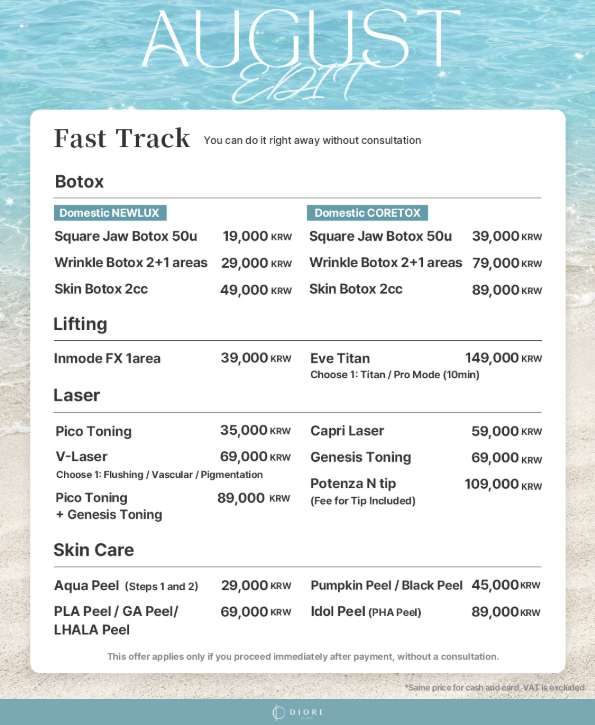
How much does age spot removal cost in Gangnam?
Pricing varies according to the number and size of spots, treatment area, technology selected, and number of sessions required. An accurate cost should be confirmed after pigmentation assessment.
Clearer, Brighter Skin at DIORE Clinic Gangnam
If you are looking for Age Spot Removal in Gangnam, Seoul, DIORE Clinic offers personalized treatment planning for age spots, sunspots, freckles, and uneven brown pigmentation.
By evaluating the type, size, depth, distribution, and intensity of pigmentation, DIORE Clinic Gangnam can develop an individualized laser or light-based treatment approach according to each patient's skin characteristics, treatment goals, and desired downtime.
For international patients visiting Korea, treatment planning can also consider travel schedules, outdoor sun exposure, important events, and whether additional pigmentation treatments may be required.
Important: A brown spot that is changing, raised, bleeding, painful, irregular, or has not been clearly identified should be medically evaluated before cosmetic laser removal.